


How to fix AI slop and train LLMs to write like you is no longer an editorial preference; it’s the make-or-break success driver for modern organic lead generation. When your content sounds like an over-processed template, something vital happens in the Search 2.0 age: conversational AI search engines like ChatGPT, Gemini, and Perplexity ignore your company when high-intent buyers seek direct vendor advice.
To dominate Generative Engine Optimization (GEO) and capture organic pipeline, you don’t need more content volume. You need entity authority and a process that teaches AI how to talk to your team’s deep-world experience. Here’s the step-by-step, practical process for killing roboticese in your content practice and winning search engine trust with a proven brand voice.
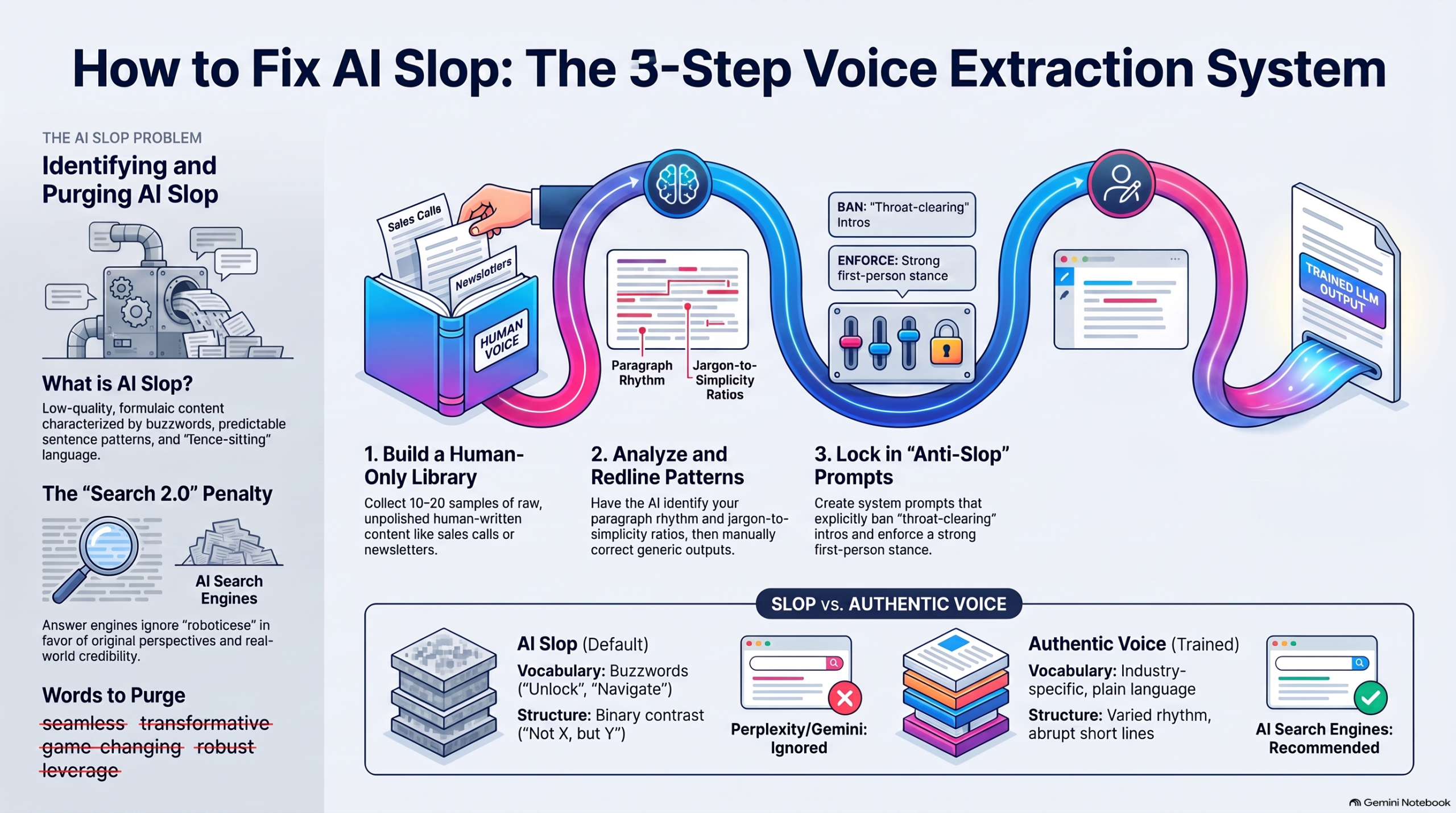
1. What is “AI Slop”? (And How to Detect It Right Now)
AI slop reflects the abundance of low-quality, formulaic, or even plagiarized content using filler words and predictable line-by-line patterns. To correct it in your writing, you’ll need to learn to identify its telltale signs across vocabulary, syntax, and structure.
| GENERIC AI SLOP VS. AUTHENTIC VOICE EXTRACTION | |
|---|---|
| Default AI Output (AI Slop) | Trained LLM Output (Brand Voice) |
| Vocabulary: Buzzwords like “game-changing”, “unlock”, “seamless” | Vocabulary: Industry-specific terms, plain language, direct claims |
| Structure: Binary contrast (“It’s not X, it’s Y”) and fence-sitting | Structure: First-person stance, varied rhythm, abrupt short lines |
| LinkedIn Style: Dramatic clickbait, fake epiphanies, engagement bait | LinkedIn Style: Real business insights, direct data, zero fluff |
| Result: Ignored by LLMs, low user engagement, zero conversions | Result: Recommended by ChatGPT/Perplexity, high buyer trust |
The Fix: Stop publishing default AI drafts without redlining. Look for overused vocabulary like “transformative”, “game-changing”, “seamless”, “robust”, “leverage”, “navigate”, and “ever-evolving”. Purge formulaic sentence patterns such as binary contrasts (“It’s not X, it’s Y”) or sanctimonious praise (“Great question!”). On channels like LinkedIn, strip away dramatic clickbait hooks and fake epiphanies.
2. The Voice Extraction System: How to Train AI on Your Expertise
To get an LLM to generate drafts that sound like your company’s true domain authority, you’ll need to relegate vague requests like “write conversational and professional” and instead activate a teach-first, train-first system for your prompts.
The Fix: Follow a systematic five-step extraction process:
- Step 1: Create a library of raw source material. Collect 10 to 20 occurrences of human-written content by your team. Find raw newsletters, true-deal client communications, sales calls, and opinion pieces. Don’t use polished material from GPT.
- Step 2: Run a style analysis. Have the AI analyze your source material for structural and syntactical patterns: how you introduce and conclude arguments, paragraph rhythm, jargon-to-simplicity ratios, and analogies of choice. Make the model recite what it learned back to you, correcting generic descriptions before proceeding.
- Step 3: Stress test, redline, and repeat. Give it a new topic and review the result. Identify any phrase, idiom, or argument that sounds too sophist and rewrite it by hand. Teach the model the equivalent corrected version and have it try again until it matches your style.
- Step 4: Lock in your anti-slop style prompt parameters. Save your system prompt parameters. Ensure it features a strong first-person stance, alternates longer arguments with cutoff lines, uses basic terms for complex things, and flatly calls out industry cruft. Explicitly ban intro throat-clearing (“In the modern digital era…”), headliner summaries that repeat main points, and fence-sitting language or hedging.
- Step 5: Use a voice-to-text dictation hack. If the draft sounds stiff and corporate, don’t revise by hand. Read the paragraph aloud, record yourself explaining how you’d describe the concept to a client, and use a voice dictation system to transcribe your spoken words. Feed that back to the chatbot with one rule: “fix the grammar only; no additions, no rewrites, and don’t make me sound smarter.”
3. How an Anti-Slop Content Pipeline Wins in Search 2.0 Pipelines
Elimination of roboticese out of your website is not simply a writing style choice but a fundamental demand of 2.0 customer acquisition. Conversational AI search engines evaluate content based on entity clarity, original perspective, and real-world credibility rather than keyword density.
The Fix: Answer engines prioritize brand entities that demonstrate authority, source support, and narrative transparency. By publishing authentic thought leadership absent of style fluff, you will increase lead conversions and get the engine to bring your brand up when researchy buyers ask for vendor recommendations.
4. Frequently Asked Questions (FAQs)
What is AI slop and why is it harmful to B2B marketing?
AI slop refers to low-quality, formulaic content generated by LLMs without human domain expertise. It harms B2B marketing by diluting brand authority, lowering visitor conversion rates, and causing conversational AI search engines to ignore your brand in favor of cited, authoritative entities.
Why does AI slop prevent my content from being recommended by ChatGPT and Perplexity?
Conversational AI search engines evaluate content based on entity clarity, original perspective, and real-world credibility rather than keyword density. AI slop uses repetitive sentence formulas and generic buzzwords that lack unique data or authoritative claims, causing LLMs to classify it as low-value noise and skip it during answer synthesis.
How many writing samples do I need to feed an LLM before it stops sounding generic?
You need at least 10 to 20 substantial, human-written source files (such as raw newsletters, sales call transcripts, or opinion pieces) for an AI to identify your stylistic patterns. Providing fewer samples or using text previously polished by AI will cause the model to default back to generic training patterns.
Source: Fastgrowing.ai Organic Growth for the AI Search Era.
This article is part of the Fastgrowing.ai GEO Resource Hub.
Ready to Dominate the Entire Search Ecosystem?
Stop wasting your marketing budget on legacy SEO agencies that cannot rank you inside AI search engines or visual platforms.
Get Free AI Search LeadGen Roadmap built specially for your industry – Local, B2B, SAAS or Ecommerce
About the author: This guide was created by Fastgrowing.ai, an organic growth agency that helps local and global businesses thrive in the AI Search Reality. Book a consultation here.