


How to rank on Google, TikTok, and AI Chatbots using Multi-Surface SEO is the biggest challenge B2B marketing teams face today. SEO used to be beautifully simple. You picked a keyword, wrote a 2,000-word blog post, built some backlinks, and waited for Google to send you traffic. Those days are officially over.
Today, the search journey is completely fragmented. Your buyers don’t just “Google it” anymore. Gen Z and Millennials are using TikTok and Instagram as their primary search engines to find products and tutorials. Meanwhile, high-intent B2B buyers are bypassing standard search entirely, asking Perplexity, Gemini, and ChatGPT to build their vendor shortlists.
If your marketing team is still only optimizing for Google, you are essentially invisible to half of your market. To survive and thrive in the SEO 2.0 era, you need a strategy that covers all bases. Here is exactly how to structure your brand’s footprint to dominate across all three major search battlegrounds.
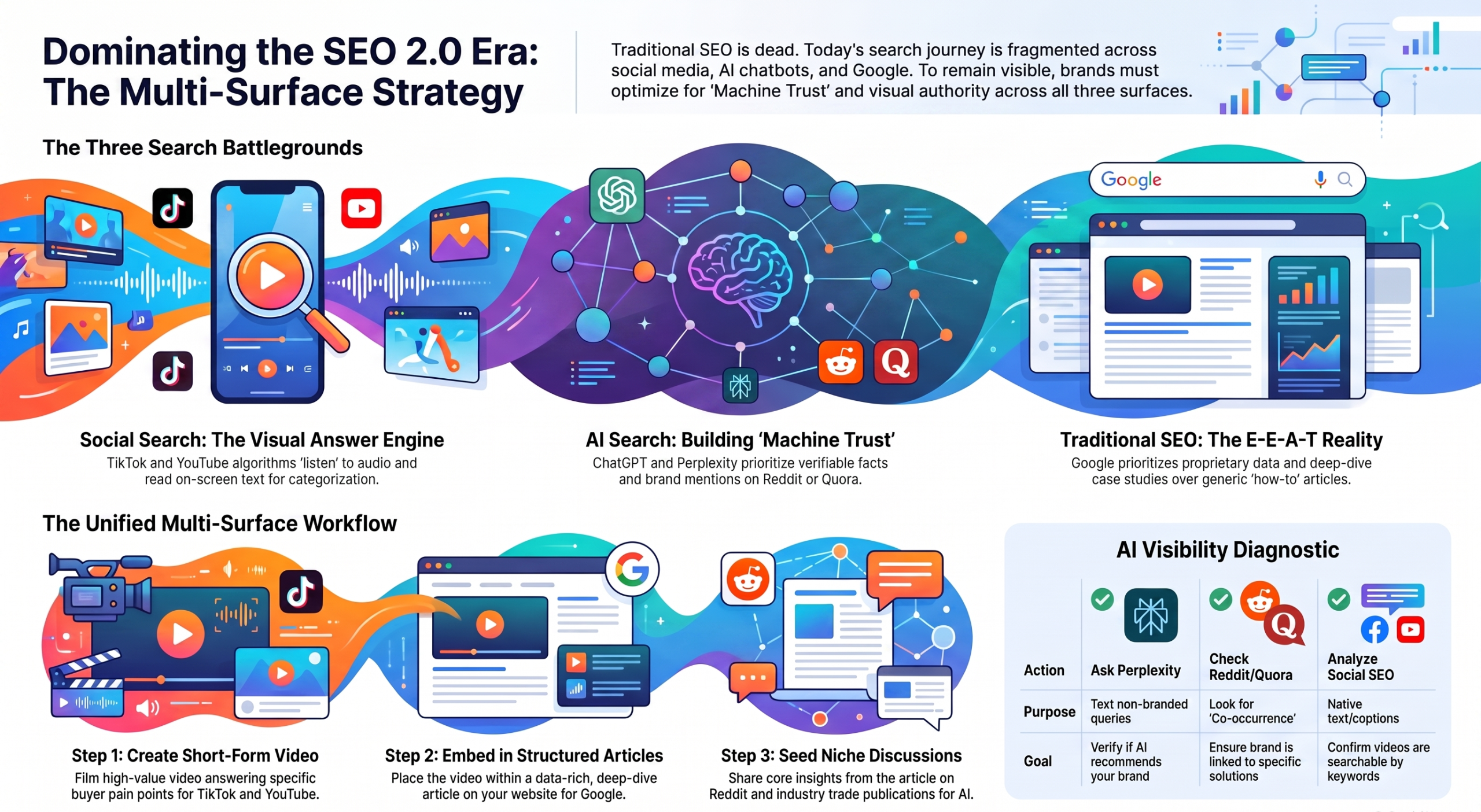
1. Social Search: Winning on TikTok and YouTube
Social media platforms are no longer just for viral entertainment; they are visual answer engines. When a user searches for a solution on TikTok or YouTube, they don’t want to read a corporate whitepaper. They want a fast, authoritative, and visual explanation.
Algorithms on these platforms scan the video’s metadata, but more importantly, they “listen” to the audio and “read” the visual text to categorize the content.
| THE MULTI-SURFACE SEARCH SHIFT | |
|---|---|
| Legacy Strategy (Single-Surface) | SEO 2.0 Strategy (Multi-Surface) |
| Focus: Google Page 1 only | Focus: Google, TikTok, YouTube, & AI Chatbots |
| Format: 2,000-word text blocks | Format: Video + Structured Data + Entity Proof |
| Tactic: Keyword stuffing | Tactic: Contextual Co-occurrence & Crowd Proof |
| Result: Vulnerable to Google algorithm updates | Result: Dominate the entire buyer search journey |
The Fix: Stop treating social media as just an engagement channel. Treat it as a search engine. Put your target keywords natively on the screen (text overlays), say them out loud in the first 3 seconds (auto-captions matter), and write keyword-rich descriptions. Answer specific user queries directly in 60-second video formats.
2. Generative AI Search: Getting Cited by ChatGPT and Perplexity
LLMs (Large Language Models) do not care about your keyword density, and they completely ignore generic corporate press releases. They are not looking for web pages; they are looking for verifiable facts. To get cited as a top recommendation in AI search, you have to build “Machine Trust.” The AI needs to see that your brand is the undisputed entity tied to a specific solution.
The Fix: AI engines scrape community forums and niche publications. To dominate this surface, you need contextual co-occurrence. You must actively generate authentic discussions about your brand on platforms like Reddit and Quora, and secure digital PR mentions alongside real industry pain points.
3. Traditional SEO: Google’s New E-E-A-T Reality
Google search isn’t dead, but the introduction of AI Overviews has fundamentally changed the SERP (Search Engine Results Page). Generic, top-of-funnel informational posts are now instantly summarized by Google’s AI, dropping click-through rates to zero. Google’s algorithm is now heavily prioritizing real human experience and deep, authoritative data that cannot be easily replicated by a bot.
The Fix: Stop publishing generic “how-to” articles. Shift your blog strategy to proprietary data, bold industry opinions, and deep-dive case studies. Give Google’s algorithm original insights that it *has* to rank because an AI cannot synthesize it from thin air.
4. The Multi-Surface Workflow
You do not need to triple your marketing budget to dominate all three surfaces. You just need a unified, multi-surface content workflow:
- Step 1: Shoot a short, high-value video answering a specific buyer pain point. (Optimizes for TikTok/YouTube)
- Step 2: Embed that video into a deeply structured, data-rich article on your website. (Optimizes for Google)
- Step 3: Seed the core insights of that article into niche trade publications and Reddit discussions. (Optimizes for ChatGPT/Perplexity)
Stop fighting over Google’s shrinking real estate. Start optimizing for the entire search ecosystem.
5. Frequently Asked Questions (FAQs)
How is Multi-Surface SEO different from traditional omni-channel marketing?
Omni-channel marketing is about distributing content everywhere. Multi-Surface SEO is about structuring data and content specifically so the search algorithms on video platforms, traditional engines, and AI chatbots actively retrieve and rank your brand for user queries.
Can B2B companies really generate leads from TikTok search?
Yes. Decision-makers use TikTok and YouTube for educational content and software comparisons. By targeting “how-to” and specific industry pain points with short-form video, B2B brands can capture high-intent search traffic on visual platforms.
How do I know if my brand is optimized for AI Chatbots?
Open Perplexity or ChatGPT and ask a non-branded, transactional question like, “Who are the best vendors for [Your Niche]?” If you aren’t recommended, your digital footprint lacks the entity structure and third-party crowd proof that LLMs require.
Source: Fastgrowing.ai Organic Growth for the AI Search Era.
This article is part of the Fastgrowing.ai GEO Resource Hub.
Ready to Dominate the Entire Search Ecosystem?
Stop wasting your marketing budget on legacy SEO agencies that cannot rank you inside AI search engines or visual platforms.
About the author: This guide was created by Fastgrowing.ai, an organic growth agency that helps local and global businesses thrive in the AI Search Reality. Book a consultation here.