


Digital PR for AI recommendations is the single most effective way to turn third-party authority into direct inbound revenue. When decision-makers ask tools like ChatGPT, Gemini, or Perplexity for vendor suggestions, these models synthesize real-world media coverage, trade reviews, and community sentiment to name specific market winners. By shifting your PR strategy from vanity press releases to machine-trusted digital footprints, you position your brand as the primary solution AI search engines present to active buyers.
1. Why Blue Links Are Bleeding Traffic to Conversational Answers
For twenty years, getting visible online meant playing a predictable game: pick a keyword, write a blog post, buy some backlinks, and hope to land on Google’s front page. But if you look at how buyers actually search today, that funnel is breaking down fast.
People don’t want to wade through ten ad-bloated links or skim 3,000-word SEO articles just to find an answer. Instead, they open a prompt window and ask point-blank questions:
“Which enterprise CRM has the best native integration for automated B2B outbound, and why?”
When the AI responds, it doesn’t give a list of options to browse. It picks two or three clear recommendations, explains why they fit, and links directly to them. If your brand isn’t in that synthesized answer, you don’t just fall down the page—you completely vanish from the buyer’s evaluation process.
2. How Large Language Models Actually Decide Who to Recommend
A lot of teams assume they can trick AI models using old-school keyword tricks. It doesn’t work. An LLM won’t trust what you say about yourself on your own website unless the rest of the web backs you up.
When AI platforms synthesize vendor recommendations, they run a quick background check across three major layers of digital proof:
1. Contextual Co-Occurrence: The machine checks how often your brand name appears right alongside your industry’s main problems and competitor names across trusted media outlets.
2. Independent Sentiment: LLMs heavily scrape news outlets, trade blogs, and real user channels to verify if people actually like and use your software. Fake press releases full of buzzwords get ignored; authentic commentary gets indexed.
3. Structured Entity Proof: The AI connects data points across verified databases to make sure your business is a real, operational entity with an established market footprint.
Digital PR for AI Recommendations & Inbound Growth
Learn how machine trust, contextual co-occurrence, and third-party media authority turn ChatGPT, Perplexity, and Gemini citations into direct inbound revenue.
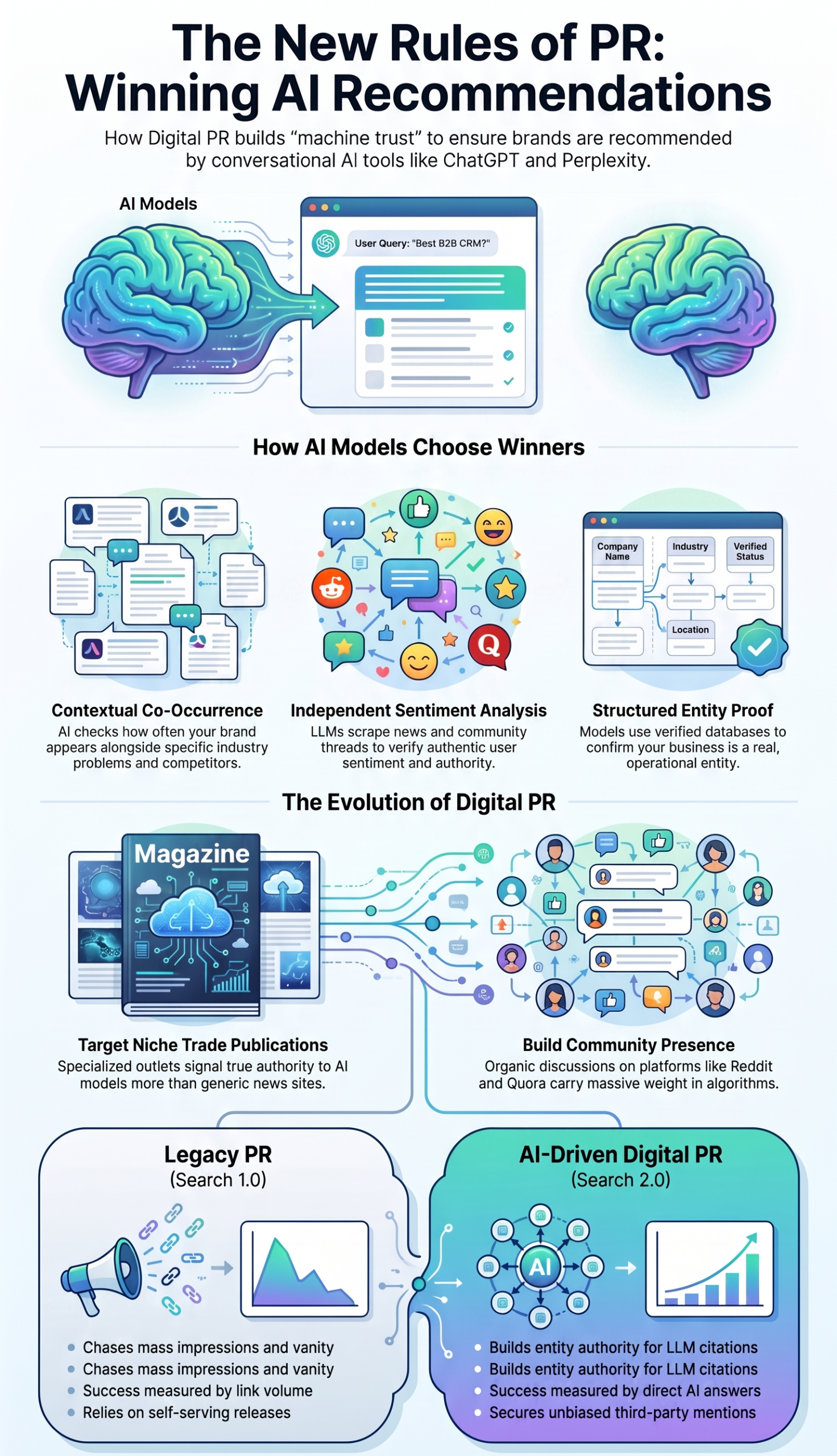
Click the image to enlarge or download it for quick reference.
3. 3 Real Digital PR Moves That Teach AI to Cite Your Brand
If you want AI models to recommend your company, your PR work needs to focus on leaving digital tracks that LLMs trust. Here is how modern growth teams pull it off:
Target Trade Publications over Vanity Outlets: A generic placement on a general news site looks nice on a wall, but a detailed mention inside a specialized trade outlet tells the AI model that you are a true niche authority.
Build Genuine Presence in Community Spaces: Models like ChatGPT and Perplexity frequently crawl platform discussions on Reddit and Quora to see what real humans say behind closed doors. Organic discussions, honest reviews, and consistent thread citations carry massive weight in AI recommendation algorithms.
Publish Original Data People Have to Quote: AI loves numbers. When you run industry surveys or publish proprietary benchmark reports, journalists quote your data. Every time another site references your study, it builds another strong link in the AI’s mind connecting your brand to market expertise.
4. Legacy PR vs. AI-Driven Digital PR
Here is a quick breakdown of how traditional public relations compares to an AI-focused approach designed for Search 2.0:
| DIGITAL PR EVOLUTION FOR SEARCH 2.0 | |
|---|---|
| Legacy PR Approach | AI-Driven Digital PR Model |
| Chases mass impressions and vanity features | Builds entity authority so LLMs cite your brand |
| Measures success by link counts and placement volume | Measures success by direct AI answers and high-intent leads |
| Relies on self-serving press releases | Secures un-biased third-party mentions across high-trust sites |
| Completely detached from direct revenue generation | Feeds directly into conversion-focused landing experiences |
Once you win the AI recommendation, the click is already warm. When a user arrives on your site from a ChatGPT or Perplexity link, they aren’t browsing casually—they’re looking to confirm what the AI told them. Match your landing page directly to their intent, and conversion becomes straightforward.
5. Frequently Asked Questions (FAQs)
How long does it take for Digital PR to influence AI responses?
Because search engine crawlers and LLM web-retrieval bots continuously scan high-trust media sites, newly established Digital PR mentions can begin shaping AI search answers within a few weeks to a couple of months.
Are traditional backlinks useless for AI search?
No, but their role has changed. Backlinks still pass domain authority, but LLMs care far more about the context around the link—specifically, what the article says about your brand and whether it positions you as a category leader.
Can small brands compete with industry giants in AI recommendations?
Yes. LLMs favor specific, highly relevant answers over raw company size. If a smaller business has tighter topical focus, better user reviews on community platforms, and clear niche mentions, AI tools will frequently recommend them over bloated legacy competitors.
Source: Fastgrowing.ai Organic Growth for the AI Search Era.
This article is part of the Fastgrowing.ai GEO Resource Hub.
Stop Losing High-Intent Buyers to AI-Recommended Competitors
Traditional SEO agencies are still selling package deals for a search landscape that is disappearing. At Fastgrowing.ai, we help forward-thinking companies dominate Search 2.0.
About the author: This guide was created by Fastgrowing.ai, an organic growth agency that helps local and global businesses thrive in the AI Search Reality. Book a consultation here.